
For your team · Directors and senior leaders
AI in the thinking, not only in the drafting.
Most senior use of AI stops at summarising and tidying prose, which is the least valuable thing it does at this level. The harder and more useful application is upstream: framing the question properly, surfacing the assumptions nobody has said out loud, and stress-testing a plan before it is committed to.
What the work looks like
Not features. The tasks this role actually brings, and what changes about them.
What people finish able to do
Taken from the course itself, not written for this page.
Apply the five-stage QUEST Framework — Question, Unpack, Explore, Scenarios, Tension — to any strategic challenge that resists a simple answer.
Reframe the presenting problem into the real strategic question before you research anything, so your analysis is aimed at what actually matters.
Surface the hidden assumptions and unstated context that shape a situation, and test the high-importance, low-confidence ones before they become expensive mistakes.
Build a structured picture of your strategic landscape — forces and trends, stakeholder dynamics, and analogous situations — using AI to reach wider and faster than you could alone.
Develop and stress-test several plausible futures with the Two-Axes Method, and attach early warning indicators that tell you which future is arriving.
Map the fundamental tensions and second-order effects that more analysis will never dissolve, and name the trade-offs honestly instead of smoothing them over.
Synthesise a full analysis into a clear, one-page Strategic Brief you can hand to a decision-maker, and check it with the TRUST principles before it leaves your hands.
Work AI as a thinking partner rather than a faster search engine, sharing organisational context safely by running the AI Safety Checklist first.
A model will agree with whatever I put in front of it.
Frequently, yes — a single model optimised to be helpful is a poor critic of a plan its user clearly likes. Running the same question across several models from different labs is the practical counterweight: where they diverge is where the reasoning is weak, and that disagreement is visible rather than averaged into one confident answer.
The course written for this role
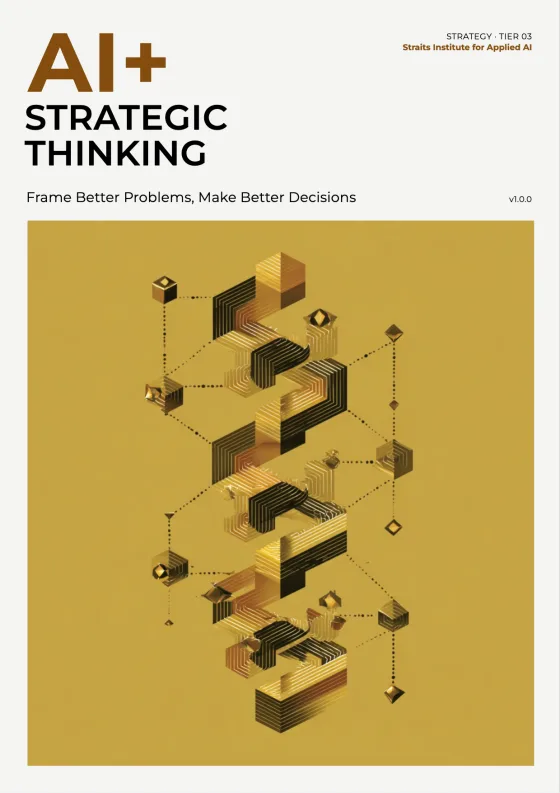
AI+ for Strategic Thinking
Frame Better Problems, Make Better Decisions
6 modules · 84 lessons · 4h 22m of video
- The Strategic Thinking Gap
- The QUEST Framework and the Question Stage
- Unpack — Surfacing Assumptions and Context
- Explore — Scanning the Strategic Landscape
- Scenarios and Tensions
- Synthesis — From Analysis to a Strategic Brief
3 courses written for this work
The lead course above, and the rest of the library for this cluster. Each has its own curriculum, its own assessment and its own certificate.
What this role asks
Taken from the courses themselves. These are the questions the people who wrote them kept being asked.
Do I need to be a senior executive to get value from this course?
No. Strategic thinking is not a C-suite skill — it is what happens whenever a professional needs to understand a challenge clearly enough to act wisely on it. The course is built for managers, senior professionals, analysts, consultants, and advisers who regularly make sense of complex situations, and the worked examples span operations, policy, banking, and the not-for-profit sector.
How much AI experience do I need before I start?
Light prerequisites. You should be comfortable using an AI assistant at a basic level. Everything the course relies on — the QUEST Framework, the prompting patterns, the way to evaluate AI output — is built from scratch here, so you do not need a prior AI qualification to follow along.
Will AI end up doing my thinking for me?
No. The whole course is organised around one line: AI is a tool to help you, not replace you. AI widens what you can see — it drafts, scans, and generates options at speed — but you decide what counts as signal, which assumptions are load-bearing, and which trade-offs you are willing to live with. You are the boss of every call.
Is it safe to share my organisation's information with an AI tool?
The course teaches you to run the AI Safety Checklist — Gauge, Understand, Authority, Risk, Decide — before you share any organisational context. It shows you how to gauge sensitivity, check where your inputs go, confirm you are permitted, weigh the worst case, and decide your route, including anonymising the context or holding it back when needed.
How much time does the course take?
Six modules of about sixty minutes each, roughly six hours in total, made of short micro-lessons you can take one at a time. Each module ends with a practice activity on supplied or dummy data, and the final module gives you a 30-day plan for applying the method to one real challenge of your own.
I already use AI for research. What does this add?
Most professionals capture about a fifth of AI's value by using it as a faster search engine. The other four-fifths sit in the thinking — reframing the question, surfacing assumptions, scanning the landscape beyond your domain, building scenarios, and mapping tensions. This course is about that larger share: using AI across the full arc of strategic analysis, not only for retrieval.
A pilot runs on your own documents, with the people who would actually use it, and the reporting comes back to whoever has to answer for it.