For your team · Healthcare teams
AI in the documentation, not in the clinical decision.
The administrative burden in healthcare is enormous and well documented, and it is where this belongs: handovers, care plans, documentation, patient communication. What follows is deliberately not clinical decision support — the boundary is the point, and drawing it clearly is what makes the rest of it usable.
What the work looks like
Not features. The tasks this role actually brings, and what changes about them.
What people finish able to do
Taken from the course itself, not written for this page.
Evaluate AI tools for clinical documentation, care planning, and patient communication — selecting appropriate tools by category and clinical context
Apply structured prompting frameworks (PRISM) to core nursing tasks including shift handovers, progress notes, care plans, and patient education materials
Design AI-assisted workflows for clinical documentation, assessment, and discharge planning that reduce administrative burden without compromising clinical safety
Implement the CHART Nursing AI Safety Protocol to govern the use of AI tools with patient data, consent considerations, and professional accountability
Build a personal AI adoption plan aligned with professional nursing standards (NMC Code and equivalents) and institutional data governance policies
This is not a medical device, and it must not behave like one.
It is not, and it is not registered as one. Nothing here diagnoses, triages or recommends treatment: the work is documentation, communication and preparation, and the clinical judgement stays with the clinician who is accountable for it. That boundary is taught explicitly rather than left for someone to discover during an incident review.
The course written for this role
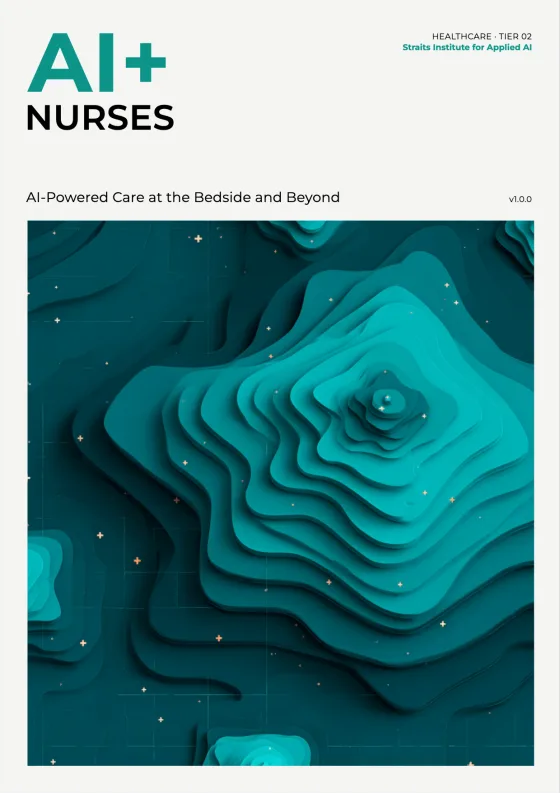
AI+ Nurses
AI-Powered Care at the Bedside and Beyond
6 modules · 103 lessons
- AI in Nursing Today
- Your AI Toolkit and Shift Handovers
- Care Planning and Patient Communication
- Clinical Documentation and Evidence-Based Practice
- AI Safety, Governance, and Clinical Risk
- Specialist Settings and Leading AI Adoption
2 courses written for this work
The lead course above, and the rest of the library for this cluster. Each has its own curriculum, its own assessment and its own certificate.

What this role asks
Taken from the courses themselves. These are the questions the people who wrote them kept being asked.
Do I need a technology background or prior experience with AI tools?
No. The course is written for senior healthcare leaders who carry clinical governance accountability, not technologists — there is no engineering and no coding. It assumes you understand the clinical environment and are now being asked to provide clinical leadership on the AI agenda. If you have read AI+ for Everyone (T1-01) frameworks such as PRISM and TRUST will be familiar; if not, the key concepts are recapped as they appear.
Will AI replace clinicians?
No. The course is explicit about what AI can and cannot do in a clinical setting, and the leader keeps accountability for patient safety and clinical quality. AI extends clinical reach without replacing clinical judgement, and every deployment is governed before it touches care.
How does this keep patients safe and manage clinical risk?
Patient safety is the spine of the course. You apply the CLEAR Healthcare AI Protocol — a safety-critical governance framework covering clinical validation, liability and accountability, equity review, approval pathways, and regulatory compliance — so an AI tool is validated and accountable before it reaches a patient.
I do not work in the NHS or the US system — does this still apply to my context?
Yes. It is built around international cases — NHS England, SingHealth, Narayana Health, Mayo Clinic, and Africa CDC — and the governance questions are the same wherever you lead. Regulatory references span the UK (CQC, MHRA), the US (FDA, HIPAA), the EU (Medical Device Regulation, EU AI Act, GDPR), and Australia (TGA).
Can I trust AI output enough to use it in a board or governance process?
Verification is built in. You evaluate AI output with the TRUST Framework before it informs a clinical or board decision, and you produce board-ready material — a governance paper and a data narrative leaders can actually adopt — that you can stand behind.
How quickly can I act, and what do I leave with?
Each of the six 60-minute modules has you watch, try, and practise on real leadership work. You leave with a board-ready healthcare AI strategy and a 90-day plan that moves your organisation toward a governance-grounded clinical AI programme, using tools you already have.
A pilot runs on your own documents, with the people who would actually use it, and the reporting comes back to whoever has to answer for it.